
Stainless Steel 304 / 304L / 304H Pipe
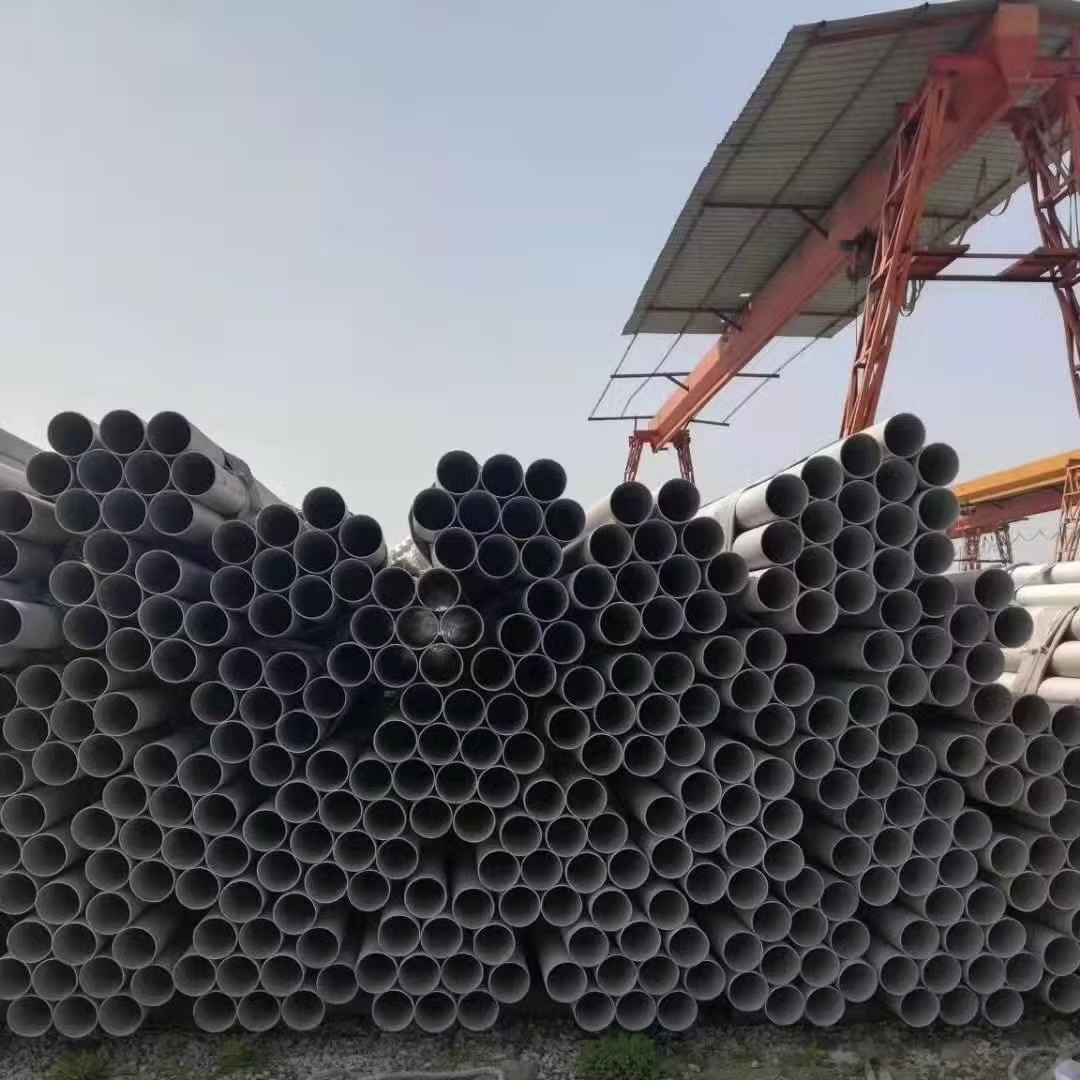
Versatile Austenitic Stainless Steel Pipes & Tubes
SS 304 Pipe is the most common grade of stainless steel used worldwide, primarily due to its excellent corrosion resistance and value. The 304L variant is the low-carbon version, which avoids harmful carbide precipitation during welding, while 304H features a higher carbon content for improved strength at elevated temperatures. These pipes are widely used in food processing, chemical plants, and architectural structures.
Technical Specifications
| Feature | Details |
|---|---|
| Standards | ASTM A312, A358, A213, A249, A269 |
| Grades | TP 304, 304L, 304H, 304N, 304LN |
| Size Range | 1/8" NB to 24" NB (Seamless), up to 48" (Welded) |
| Schedules | SCH 5, 10S, 40S, 80S, 160, XXS |
| Manufacturing | Seamless / ERW / EFW / Welded / Fabricated |
| End Finish | Plain End, Beveled End, Threaded |
Mechanical Properties
| Property | Grade 304 | Grade 304L | Grade 304H |
|---|---|---|---|
| Yield Strength (0.2% Offset) | Min 205 MPa | Min 170 MPa | Min 205 MPa |
| Tensile Strength (Min) | 515 MPa | 485 MPa | 515 MPa |
| Elongation (Min %) | 40% | 40% | 40% |
| Hardness (Rockwell B) | Max 92 HRB | Max 92 HRB | Max 92 HRB |
Chemical Composition (%)
| Element | SS 304 | SS 304L | SS 304H |
|---|---|---|---|
| Carbon (C) | 0.08 max | 0.03 max | 0.04 - 0.10 |
| Manganese (Mn) | 2.00 max | 2.00 max | 2.00 max |
| Chromium (Cr) | 18.0 - 20.0 | 18.0 - 20.0 | 18.0 - 20.0 |
| Nickel (Ni) | 8.0 - 11.0 | 8.0 - 12.0 | 8.0 - 11.0 |
| Silicon (Si) | 0.75 max | 0.75 max | 0.75 max |
| Nitrogen (N) | 0.10 max | 0.10 max | - |
| Phosphorus (P) | 0.045 max | 0.045 max | 0.045 max |
| Sulfur (S) | 0.030 max | 0.030 max | 0.030 max |
Features and Benefits of SS 304 Pipe
- Excellent corrosion resistance in a wide variety of atmospheric environments
- 304L grade offers high weldability without post-weld annealing
- 304H grade provides superior creep resistance for high-heat service
- Outstanding cryogenic toughness for low-temperature applications
- Easy to clean and maintain, making it ideal for the food & beverage industry
- Non-magnetic property in the annealed condition
- Excellent formability and drawing properties
- Fully recyclable and environmentally friendly material
Applications & Uses
Food Processing
Standard material for milk, beer, and wine processing equipment and storage tanks.
Chemical Lab
Resistant to organic chemicals, dyestuffs, and a wide variety of inorganic chemicals.
Architecture
Used for railings, cladding, and structural elements in both interior and exterior designs.